Why Most Early-Stage Businesses Struggle with Client Acquisition (And What Actually Works)
What actually works when it comes to client acquisition in early-stage businesses? In this article, Eddington Pindura shares real-world lessons from working with startups and growing businesses — revealing why most struggle to attract consistent clients, and what finally creates predictable enquiry flow. You’ll discover the common patterns, key mistakes, and a simple 4-stage framework (PCF Method™) that helps turn visibility into real client conversations and conversions.
CLIENT ACQUISITIONDIGITAL MARKETINGSTRATEGY BUSINESS GROWTH
Eddington Pindura | Digital Growth Strategist | Founder of Internet Marketing HQ
3/22/20262 min read
The Reality of Client Acquisition at Early Stage
One thing I’ve noticed working with early-stage businesses…
Client acquisition rarely fails because people aren’t trying hard enough.
If anything, it’s the opposite.
Most founders are doing a lot — posting, networking, tweaking offers, trying different platforms.
But the enquiries?
Still inconsistent.
One week things look promising.
The next… silence.
And that’s where frustration sets in.
Because it feels like effort should equal results.
But in reality, early-stage client acquisition isn’t just about doing more.
It’s about doing the right things — in the right order.
Why Most Early-Stage Businesses Struggle (It’s Not What They Think)
Most people assume the issue is:
• Not enough visibility
• Not enough marketing
• Not enough time
But from what I’ve seen, that’s rarely the real problem.
The real issue is lack of structure.
There’s no clear journey from:
👉 “Someone discovers you”
to
👉 “They become a client”
So what happens?
Activity increases…
But results stay unpredictable.
It’s not a volume problem.
It’s a flow problem.
The Pattern I Keep Seeing Across Different Businesses
Across different founders, industries, and business models…
The pattern is surprisingly consistent.
Most businesses are doing one or two things well, but missing the full picture.
For example:
• Strong visibility… but no trust built
• Good conversations… but no clear conversion path
• Great skills… but no positioning
So enquiries come in occasionally…
But not consistently.
And without consistency, growth becomes reactive instead of predictable.
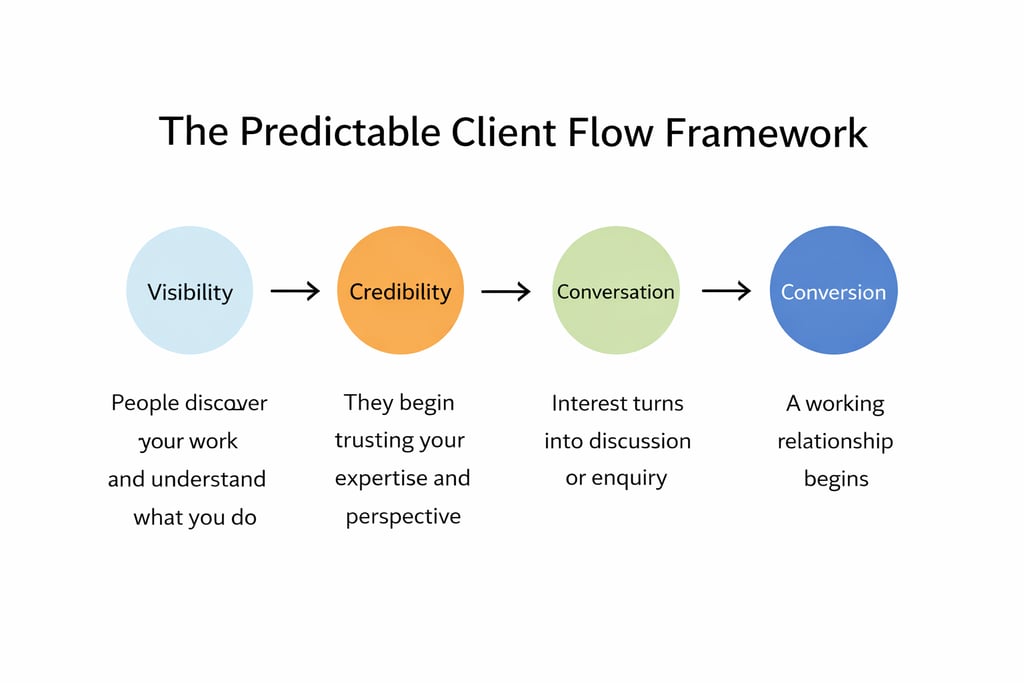
The 4 Stages of Predictable Client Flow (PCF Method™)
This is where things start to click.
Because when you look closely, client acquisition isn’t random.
It follows a sequence.
I call it:
The Predictable Client Flow (PCF Method™)
A simple 4-stage model:
1. Visibility
People discover you and what you do.
2. Credibility
They begin to trust your perspective and expertise.
3. Conversation
Interest turns into discussion or enquiry.
4. Conversion
A working relationship begins.
Most early-stage businesses don’t have a problem with effort.
They have gaps in this sequence.
And wherever there’s a gap…
That’s where the flow breaks.
Where Things Break Down (And Why Enquiries Stay Inconsistent)
This is where things become clearer.
Because once you understand the stages, you start to see the bottlenecks.
Common examples:
• Stuck at visibility (posting, but no engagement)
• No credibility (people see you, but don’t trust yet)
• Conversations happening… but no clear next step
• No conversion process (people drop off)
So the issue isn’t:
👉 “Why am I not getting clients?”
It’s:
👉 “Where is my flow breaking?”
That’s a very different question.
And a much more useful one.
What Actually Starts to Fix It
The shift happens when you move from:
👉 random activity
to
👉 structured flow
That means:
• Being intentional about how people discover you
• Building trust before expecting conversion
• Guiding conversations instead of hoping they lead somewhere
• Creating a simple path to working with you
It’s less about doing more.
And more about connecting the dots.
Final Thought: From Activity to Predictability
Client acquisition starts to feel very different when you stop relying on momentum…
…and start building structure.
Because once the flow is working:
• You’re not guessing what to do next
• You’re not chasing every opportunity
• You’re not relying on luck
You’re building something repeatable.
And that’s when things begin to stabilise.
If You’re Navigating This Right Now…
I’ve put together a short guide that breaks this down further:
👉 From Inconsistent Enquiries to Predictable Client Flow
It walks through the same framework in a simple, practical way.
You can download it here:
The Predictable Client flow Framework
📍 Our Location
Newmarket, Suffolk (UK)
Serving UK-wide
Contacts
Mon–Fri, 9am–5pm
Online via Zoom/Google Meet
Turn Inconsistent Enquiries into Predictable Client Flow
Takes 30 seconds. No spam. Just practical steps.
Download the step-by-step system I use to turn inconsistent enquiries into predictable client flow.
Plus occasional tips to help you grow.