What Is a Sole Trader Business? Advantages, Disadvantages and Key Responsibilities
Learn what a sole trader business is, the advantages and disadvantages of this business structure, key tax responsibilities, and important considerations for entrepreneurs starting a business in the UK.
Eddington Pindura
6/17/20263 min read
Understanding Sole Trader Businesses
Introduction
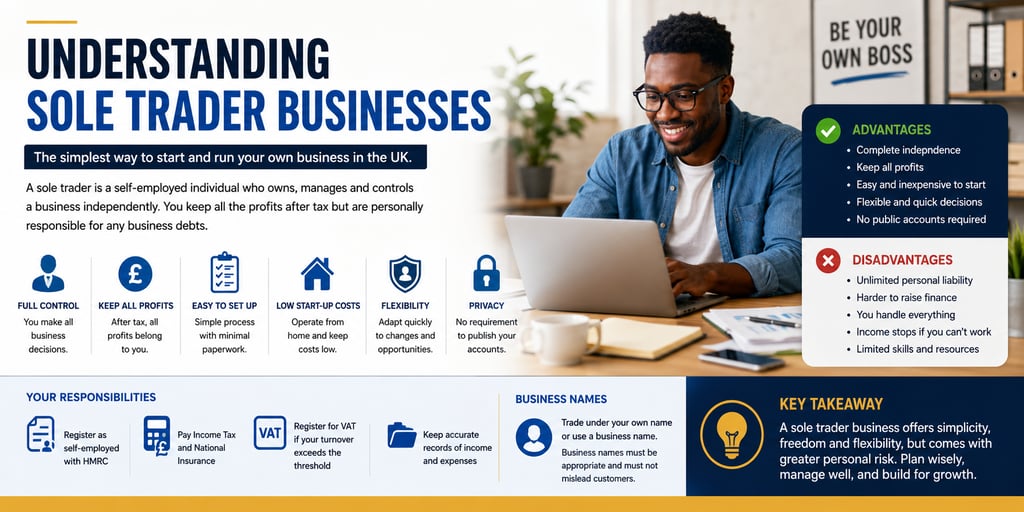
A sole trader is the simplest and most common form of business ownership in the UK. A sole trader is a self-employed individual who owns, manages, and controls a business independently.
Many entrepreneurs choose this business structure when starting a new venture because it is easy to establish, offers complete control, and involves relatively few legal requirements.
However, while sole traders retain all profits generated by the business, they also carry full responsibility for any debts or financial obligations incurred by the business.
Key Characteristics of a Sole Trader
A sole trader:
Owns and controls the business alone.
Makes all business decisions independently.
Keeps all profits after taxes.
Is personally responsible for business debts.
Registers as self-employed with HM Revenue & Customs (HMRC).
Completes an annual Self-Assessment tax return.
Examples of sole traders include:
Freelance graphic designers
Consultants
Plumbers and electricians
Online business owners
Market traders
Independent digital marketers
Advantages of Being a Sole Trader
1. Full Control
The owner has complete authority over business decisions without needing approval from shareholders, directors, or partners.
2. Keeps All Profits
After paying taxes and expenses, all remaining profits belong to the business owner.
3. Easy to Set Up
Starting as a sole trader is straightforward and involves minimal paperwork compared to forming a limited company.
4. Low Start-Up Costs
Many sole traders begin operating from home, reducing overhead expenses such as office rental and staffing costs.
5. Privacy
Unlike limited companies, sole traders are not required to publish company accounts publicly.
6. Flexibility
Business owners can quickly adapt products, services, or pricing without lengthy approval processes.
Disadvantages of Being a Sole Trader
1. Unlimited Liability
The biggest disadvantage is that the owner is personally liable for all business debts.
If the business cannot meet its financial obligations, personal assets such as savings, vehicles, or property may be at risk.
2. Limited Access to Finance
Sole traders may find it more difficult to secure large loans or attract investors because ownership cannot be divided into shares.
3. Workload and Responsibility
The owner is responsible for all aspects of the business, including:
Marketing
Finance
Customer service
Operations
Compliance
This can result in long working hours and increased pressure.
4. Business Continuity Risks
If the owner becomes ill or unable to work, business operations and income may be affected.
5. Limited Skills and Expertise
A sole trader may not possess all the specialist skills needed to grow the business effectively.
Tax Responsibilities of Sole Traders
Registering with HMRC
Individuals must register as self-employed with HMRC when they begin trading.
Registration enables the business owner to:
Pay Income Tax
Pay National Insurance Contributions (NICs)
Complete annual Self-Assessment tax returns
Income Tax
Sole traders pay Income Tax on their taxable profits after allowable business expenses have been deducted.
Examples of allowable expenses include:
Office costs
Travel expenses
Marketing costs
Insurance
Equipment and software subscriptions
National Insurance Contributions
Self-employed individuals may be required to pay National Insurance depending on their level of profits and current HMRC regulations.
Value Added Tax (VAT)
Businesses whose annual taxable turnover exceeds the current VAT registration threshold must register for VAT.
Businesses below the threshold may choose to register voluntarily if beneficial.
Record Keeping Requirements
Accurate record keeping is essential for legal compliance and effective business management.
Sole traders should maintain records of:
Sales and income
Business expenses
Bank statements
Invoices and receipts
Tax returns
VAT records (if applicable)
Modern businesses often use digital accounting software such as:
Xero
QuickBooks
FreeAgent
These systems help businesses comply with HMRC's digital reporting requirements.
Business Names
A sole trader can:
Trade under their own name; or
Use a business trading name.
Examples:
Eddington Pindura
Eddington Pindura trading as SMB Success Engine
Business names must not:
Be offensive.
Mislead customers.
Suggest a connection with government or public authorities without permission.
Is Sole Trader Status Suitable for Entrepreneurs?
For many new entrepreneurs, the sole trader model provides an excellent starting point because it offers:
Simplicity
Flexibility
Low costs
Fast decision-making
However, as a business grows, owners may consider changing to a limited company structure to benefit from:
Limited liability protection
Improved credibility
Greater investment opportunities
Potential tax planning advantages
Conclusion
The sole trader structure remains one of the most popular forms of business ownership in the UK. It is particularly suitable for start-ups, freelancers, consultants, and small business owners seeking complete control and a straightforward business setup. However, entrepreneurs must carefully consider the risks associated with unlimited liability and limited access to external funding before choosing this legal structure.
Critical Thinking Question:
Would the advantages of complete control outweigh the risks of unlimited liability for a new entrepreneur starting a digital marketing business? Explain your answer using examples.
Continue Your Business Learning Journey
Understanding sole trader businesses is just one step in building a strong foundation in business and entrepreneurship.
If you're interested in developing your business knowledge further, access our free Business Management & Entrepreneurship Resource Hub, which includes practical templates, business tools, study resources and entrepreneurial guides designed to help you apply business concepts in the real world.
✔ Business Structure Guide
✔ SWOT Analysis Template
✔ PESTLE Analysis Template
✔ SMART Goals Worksheet
✔ AI for Business Checklist
✔ Marketing Planning Template
👉 Get instant access to the Resource Hub here
Not sure where to start? Our AI Receptionist in the bottom right hand corner is available 24/7 to answer questions, recommend resources and help guide your learning journey.
Further Reading
For the latest information regarding self-employment, taxation and business registration requirements, readers should consult official guidance provided by GOV.UK and HM Revenue & Customs (HMRC), as regulations and thresholds may change over time.
📍 Our Location
Newmarket, Suffolk (UK)
Serving UK-wide
Contacts
Mon–Fri, 9am–5pm
Online via Zoom/Google Meet
Turn Inconsistent Enquiries into Predictable Client Flow
Takes 30 seconds. No spam. Just practical steps.
Download the step-by-step system I use to turn inconsistent enquiries into predictable client flow.
Plus occasional tips to help you grow.